
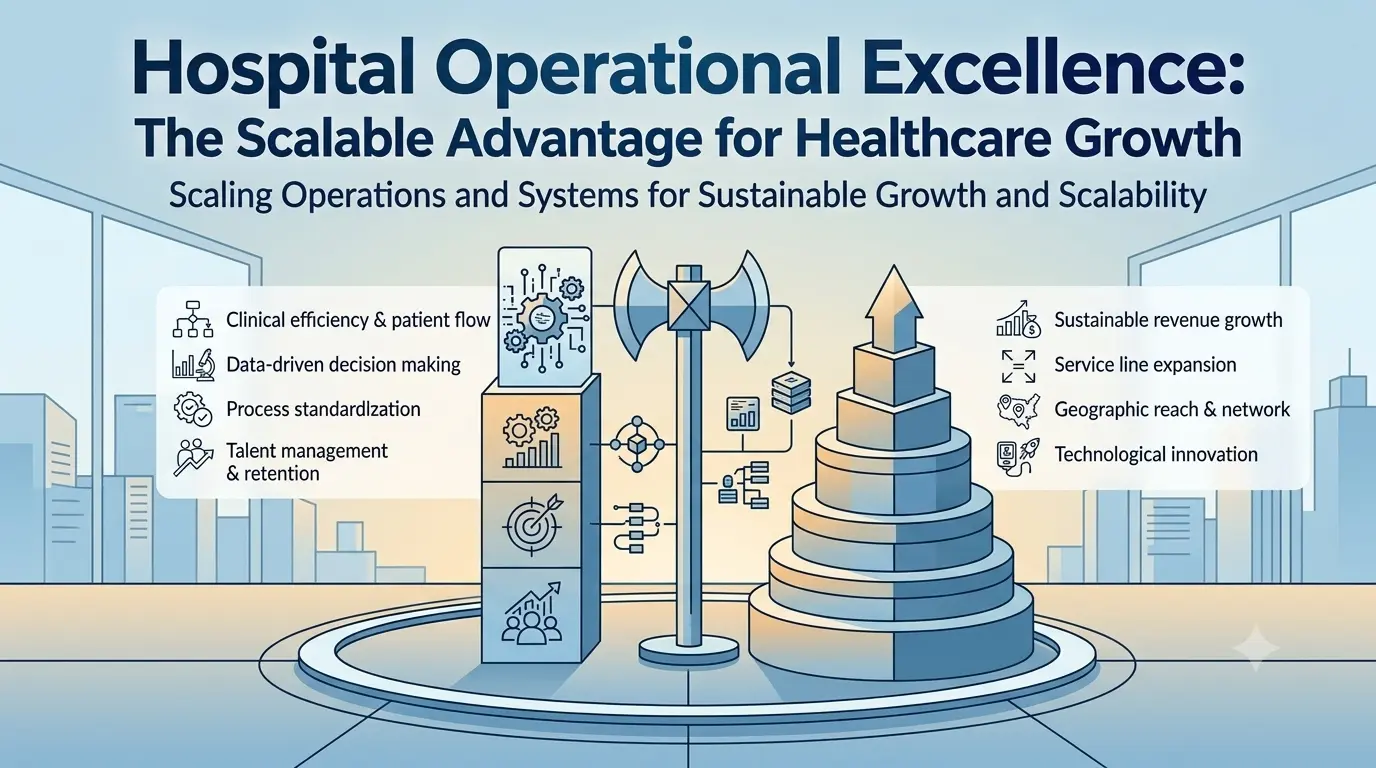
A hospital can buy capacity. It can invest in technology, recruit doctors, build new facilities and increase its marketing budget. But one thing is much harder to buy: operational discipline.
Imagine a hospital at 11:30 in the morning. The OPD waiting area is full. Consultants are seeing patients. The pharmacy has a queue. Billing counters are occupied, nurses are moving between wards and the emergency department has patients waiting.
From the outside, the hospital appears busy and successful.
But the operational dashboard tells a different story.
Bed occupancy may be only 54%. The OT may have unused slots. Discharges planned before noon may still be pending. Insurance files may be waiting for documentation. Diagnostic capacity may remain unused during parts of the day.
The hospital may be spending aggressively on marketing, recruiting additional employees and planning another 100 beds, while OPD-to-IP conversion remains stagnant.
The underlying issue may not be demand alone. It may be hospital operational efficiency.
This is where hospital operational excellence becomes critical.
What Is Hospital Operational Excellence?
Hospital operational excellence is the ability of a healthcare organization to consistently convert its available people, infrastructure, technology, time and capital into predictable outcomes with minimum friction, variation and waste.
Operational excellence is often misunderstood as cost-cutting, creating SOPs or tracking more KPIs. In reality, it is much broader.
For a hospital, operational excellence connects:
- Patient flow
- Capacity utilization
- Process efficiency
- Clinical and administrative coordination
- Patient experience
- Employee productivity
- Revenue
- Cash flow
- Accountability
- Continuous improvement
The central question is not simply:
“How busy is the hospital?”
It is:
“How effectively is the hospital converting its available resources into outcomes?”
That distinction can fundamentally change how hospital leaders approach growth.
Why Hospital Operational Excellence Matters
A hospital is not simply a collection of independent departments.
OPD has its targets. Nursing has its targets. Radiology, pharmacy, billing, finance and marketing all have their own metrics.
But patients do not experience a hospital department by department.
They experience one connected journey.
Consider a typical discharge.
A doctor completes the discharge summary at 11:00 AM. However, the pharmacy bill is not closed. The insurance desk is waiting for documentation. The final bill is delayed. The patient continues waiting, the bed remains occupied and housekeeping cannot release it for the next admission.
Everyone involved may be working hard.
Yet the overall system is inefficient.
This is the difference between departmental efficiency and organizational efficiency.
Hospital operational excellence focuses on the entire patient journey rather than optimizing departments in isolation.
The Five Layers of Hospital Operational Excellence
A scalable hospital operating system can be viewed through five interconnected layers:
- Flow
- Capacity
- Process
- Performance
- Accountability
1. Patient Flow
Start with the patient.
Where does the patient move?
Where does the patient wait?
Where does information wait?
Where does a decision wait?
Where does money wait?
A typical patient journey may look like:
Appointment → Registration → Consultation → Diagnostics → Admission → Treatment → Discharge → Billing → Follow-up
Every handoff can create friction.
A hospital may believe it has a bed shortage when the real issue is delayed discharge. It may believe it has an OPD demand problem when the real issue is appointment scheduling. It may believe it needs additional emergency capacity when the underlying problem is admission or transfer coordination.
Therefore, hospital process improvement should begin by identifying where the patient journey slows down.
2. Capacity Utilization
The second question is:
How much of the capacity the hospital already owns is being converted into productive output?
A hospital may have 100 beds, but if only 55 are occupied, 45 beds represent unused capacity at that point in time.
An OT may have 10 available slots, but if three remain unused, purchased capacity is not being fully utilized.
A CT scanner may be operational for 12 hours, while demand is concentrated into only four hours.
A consultant may be available for six hours but have poorly distributed appointments.
This illustrates an important principle:
Capacity is not the same as infrastructure.
Capacity is the organization’s ability to convert infrastructure, people and time into productive output.
Before investing in additional infrastructure, hospital leaders should understand the utilization of their existing resources.
3. Process Standardization
A critical question for healthcare leaders is:
Does a process work because the system is effective, or because one individual knows how to make it work?
If a billing manager personally knows whom to call to release an insurance file, that knowledge is valuable. But it may not represent a scalable process.
If one nurse knows how to coordinate difficult discharges, that is valuable experience. But the organization should not depend entirely on that individual’s presence.
A mature healthcare organization converts individual knowledge into institutional capability.
The progression should be:
Person → Process → Standard → Owner → Measurement
That is how hospital operations become scalable.
4. Performance Management
Dashboards and KPIs are important, but measurement is not management.
A hospital can have hundreds of KPIs and still lack operational control.
A useful hospital performance management system should answer:
- What is going wrong?
- Where is it happening?
- How frequently is it happening?
- Who owns the issue?
- What action is required?
- By when?
For example, an Average Length of Stay (ALOS) figure tells leadership what happened. It does not necessarily explain why.
If ALOS is high, leaders need to investigate whether the cause is:
- Delayed diagnostics
- Consultant review
- Insurance approval
- Discharge documentation
- Clinical complexity
- Social factors
- Poor coordination
The KPI identifies the signal.
Operational management identifies the cause and determines the response.
5. Accountability
The final layer is accountability.
Statements such as:
- Discharge is delayed.
- Occupancy is low.
- Billing is pending.
- OT utilization is poor.
- Patients are waiting.
- Revenue is below budget.
are observations.
They are not accountability.
A mature operating system converts an observation into:
Metric → Owner → Target → Review Frequency → Corrective Action
The question therefore changes from:
“Why is this happening?”
to:
“Who owns fixing it, and by when?”
That is where operational discipline becomes part of the organization’s management system.
The Hidden Cost of Poor Hospital Operations
Operational inefficiency rarely appears as one obvious line item in the profit and loss statement.
Instead, it appears through multiple forms of leakage.
Revenue Leakage
Revenue can be affected by:
- Missed services
- Incorrect packages
- Unbilled consumables
- Rejected claims
- Incomplete documentation
Capacity Leakage
Capacity can be lost through:
- Unused beds
- Underutilized OT slots
- Idle diagnostic capacity
- Poor consultant scheduling
Time Leakage
Time can be lost through:
- Patient waiting
- Delayed discharges
- Repeated documentation
- Multiple approvals
- Poor coordination
Talent Leakage
Highly paid managers may spend significant time solving repetitive problems that should have been addressed through better processes.
Patient Leakage
A patient who waits too long or repeatedly has to ask for updates may have a poor experience and may not return.
Cash Leakage
Delayed billing, pending insurance claims, ageing receivables and unresolved deductions can affect hospital cash flow.
Together, these forms of leakage can materially affect hospital economics.
Why Growth Can Magnify Operational Problems
Consider a 100-bed hospital planning to become a 300-bed hospital.
At first glance:
100 beds → 300 beds = 3X capacity
But operational complexity does not simply remain unchanged.
Expansion can bring:
- More doctors
- More nurses
- More shifts
- More patient movement
- More diagnostics
- More pharmacy transactions
- More insurance claims
- More vendors
- More billing
- More discharge coordination
- More clinical handoffs
- More data
- More escalations
A process that worked when the CEO personally knew every HOD may fail when the organization has dozens of departments.
An operations manager cannot personally solve every patient-flow issue as the hospital grows.
That is where the difference between growth and scalability becomes important.
Growth adds volume.
Operational excellence makes that volume manageable.
Operational Excellence Is Not About Removing Human Judgment
Healthcare is not a factory.
Every patient is different. Clinical decisions require professional judgment, and operational excellence should not attempt to eliminate that judgment.
Instead, hospitals can standardize the environment surrounding clinical decision-making.
Processes that can often be standardized include:
- Admission workflows
- Discharge processes
- Escalation mechanisms
- Documentation
- Patient communication
- OT scheduling
- Billing workflows
- Inventory controls
The principle is simple:
Standardize the process. Preserve professional judgment.
Should a Hospital Add More Capacity?
Hospital expansion requires more than a financial or infrastructure assessment.
Suppose a hospital is operating at 60% occupancy and plans to add another 100 beds.
Before investing additional capital, leadership should ask:
Have we maximized the operating potential of the capacity we already have?
Potential operational constraints may include:
- Beds blocked by discharge delays
- Underutilized OT slots
- Poor OPD conversion
- Inefficient consultant scheduling
- Insurance-related admission delays
- Revenue leakage
- Underutilized diagnostics
- Fragmented patient flow
If these problems exist, the first growth opportunity may not be another building.
It may be better hospital operations.
This is why operational excellence is not merely an operations function. It can become an important part of a hospital’s growth strategy.
Seven Questions Every Hospital CEO Should Ask
Hospital leaders do not necessarily need hundreds of questions to identify operational constraints.
Start with seven:
- Where does the patient wait unnecessarily?
- Where does capacity remain unused?
- Where does revenue leak from the patient journey?
- Which critical processes depend on individual people?
- Which problems continue recurring despite repeated reviews?
- Does every important operational metric have a clear owner?
- If patient volume doubled tomorrow, which part of the operating system would break first?
The final question is particularly important.
Expansion does not only test a hospital’s business strategy.
It tests the operating system.
The AkoMentis Operating Discipline Model
A practical operational improvement model can follow six stages:
Observe
Understand what is actually happening—not simply what the SOP or dashboard says.
Look at what patients, employees and processes actually experience.
Diagnose
Identify the real constraint.
Is the problem related to:
- Manpower?
- Process?
- Capacity?
- Technology?
- Leadership?
- Coordination?
- Ownership?
Design
Redesign the process around the desired outcome.
Standardize
Make the improved way of working repeatable.
Measure
Track the few metrics that matter rather than creating unnecessary KPI complexity.
Improve and Scale
Use data and frontline feedback to continuously remove friction.
Only after a process works consistently should it be replicated across departments, facilities or geographies.
Do not scale a process simply because it exists. Scale it because it works.
From Hospital Growth to Hospital Scale
There is an important difference between growth and scale.
Growth can come from adding:
- Beds
- Doctors
- Locations
- Equipment
- Marketing
- Capital
Scale requires something more.
The organization must produce consistent outcomes without increasing complexity at the same rate as patient volume.
That requires:
- Patient flow
- Capacity utilization
- Strong processes
- Performance management
- Accountability
- Operational discipline
When these elements work together, the same infrastructure can potentially produce more value, teams can spend less time chasing problems and leadership can become less dependent on individual heroics.
That is the real meaning of hospital operational excellence.
The Real Scalable Advantage
Hospitals can buy technology.
Competitors can buy the same technology.
Hospitals can hire doctors.
Competitors can hire doctors.
Hospitals can build larger facilities.
Competitors can build larger facilities.
Hospitals can increase their marketing budgets.
Competitors can do the same.
But deeply embedded operational discipline is harder to replicate because it exists within:
- Processes
- People
- Habits
- Data
- Accountability
- Culture
- Management routines
That is why operational excellence can become a strategic advantage.
It is not simply about making a hospital more efficient.
It is about making the organization more predictable.
And predictable organizations are better positioned to scale.
Is Your Hospital Ready to Scale?
Before adding another 100 beds, opening another facility, increasing the marketing budget or adding another layer of management, ask one question:
“If patient volume doubled tomorrow, would our operating system absorb it—or would our people simply have to work twice as hard?”
The answer can reveal whether the hospital is ready for growth or ready for scale.
Because growth adds volume.
Hospital operational excellence makes that volume manageable.
And operational discipline turns that capability into scale.
Frequently Asked Questions About Hospital Operational Excellence
What is hospital operational excellence?
Hospital operational excellence is the ability to consistently convert healthcare resources—including people, infrastructure, technology and time—into predictable outcomes while reducing unnecessary friction, variation and waste.
Why is operational excellence important in hospitals?
It can help hospitals improve patient flow, capacity utilization, process consistency, accountability, patient experience and financial performance while creating a stronger foundation for sustainable growth.
What are the key components of hospital operational excellence?
Key components include patient flow, capacity utilization, process standardization, performance measurement and accountability. Continuous improvement is also essential for maintaining operational performance.
How can hospitals improve operational efficiency?
Hospitals can begin by mapping the patient journey, identifying bottlenecks, measuring capacity utilization, standardizing critical workflows, assigning process ownership and reviewing recurring operational problems.
What is the difference between hospital growth and scalability?
Growth often involves adding beds, doctors, locations, equipment or capital. Scalability requires an organization to handle increasing patient volume without increasing operational complexity at the same rate.
How does operational excellence improve hospital scalability?
A scalable operating system reduces dependence on individual employees, standardizes important processes, clarifies ownership and creates consistent management routines. This allows the organization to handle greater volume more predictably.