
Hospital expansion is often viewed as a construction and investment decision. But financially, it is much more than building a new facility or adding beds.
A successful hospital expansion strategy must answer a more difficult question:
Can the existing business financially support the new hospital until the new facility becomes operationally and financially mature?
A hospital project may have a strong location, a large catchment area, experienced architects, a recognised brand and apparently available financing. Yet the project can still create financial pressure if the promoter underestimates pre-opening costs, working capital, recruitment, doctor commitments, interest during construction and the time required to build patient volumes.
This is why hospital expansion planning should begin with a detailed cash-flow and operating model—not simply an architectural plan.
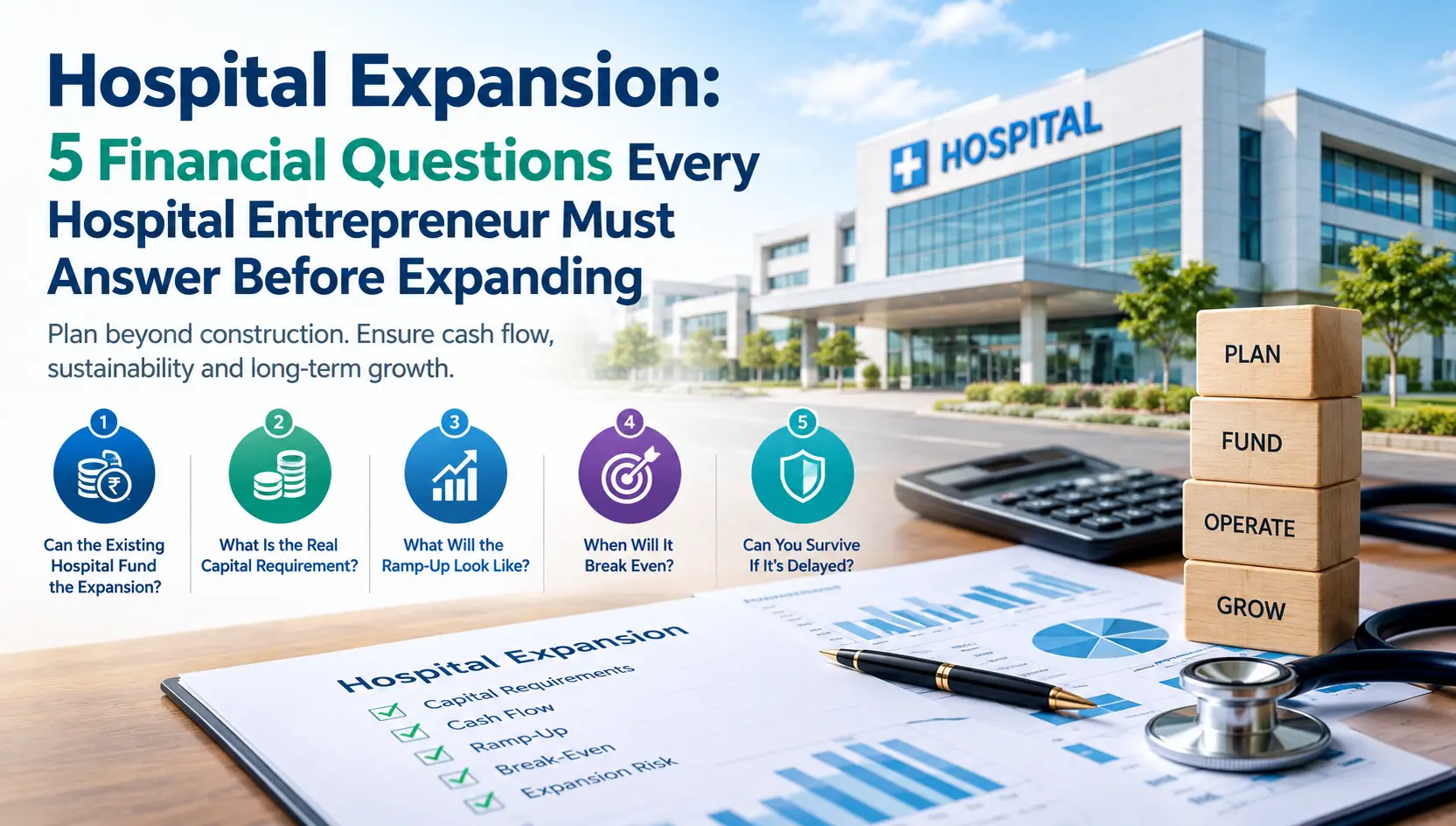
Before committing capital to a new hospital, hospital entrepreneurs and management teams should answer five financial questions:
- Can the existing hospital actually fund the expansion?
- What is the real capital and funding requirement?
- What will the hospital’s ramp-up actually look like?
- When will the new hospital really break even?
- Can the promoter survive if the expansion plan is delayed?
What Is Hospital Expansion?
Hospital expansion refers to increasing healthcare capacity through a new hospital, additional beds, a new facility, additional clinical services, or expansion into a new location.
However, expansion is not simply a matter of adding physical capacity.
A new hospital creates financial obligations before it generates mature revenue.
These may include:
- Land and construction
- Medical equipment
- IT systems
- Furniture and interiors
- Licenses and statutory approvals
- Recruitment
- Consultant onboarding
- Employee salaries before opening
- Training
- Branding
- Launch marketing
- Pharmacy and consumable inventory
- Pre-opening expenses
- Interest during construction
- Working capital
- Initial operating losses
Therefore, the financial question is not simply:
“How much will it cost to build the hospital?”
It is:
“How much cash will the business need until the hospital becomes self-sustaining?”
That distinction is fundamental to hospital expansion finance.
1. Can the Existing Hospital Actually Fund the Expansion?
This should be the first question in any hospital expansion strategy because a new hospital will usually not generate mature cash flow immediately after opening.
A mature hospital may generate healthy EBITDA. But EBITDA is not the same as cash available for expansion.
Existing hospitals have their own financial commitments, including:
- Working capital requirements
- Debt repayments
- Equipment replacement
- Doctor payouts
- Employee costs
- Tax obligations
- Maintenance capital expenditure
- Technology investments
- Other operating commitments
So the real question is not:
“Is our existing hospital profitable?”
The more useful question is:
“How much cash can the existing hospital consistently generate after meeting its own obligations?”
Example: Existing Hospital Cash Generation
Imagine an existing hospital generates ₹5 crore of EBITDA annually.
At first glance, a promoter may think:
“We have ₹5 crore of operating surplus. We can use that to support the new hospital.”
But suppose the existing hospital also requires:
- ₹1 crore for annual maintenance capex
- ₹1 crore for debt repayment
- ₹1 crore increase in working capital
- ₹50 lakh for tax and other obligations
- ₹50 lakh for technology and equipment replacement
The genuinely deployable cash is therefore very different from the EBITDA figure.
Now imagine the new hospital requires ₹8–10 crore of additional cash support every year during its initial ramp-up.
The existing hospital may be profitable, but the overall group could still become cash constrained.
This distinction becomes particularly important when a promoter is expanding from one hospital to two or three facilities.
The 24–36-Month Stress Test
A useful board-level question is:
If the new hospital produces almost no meaningful cash for the first 24–36 months, can the existing business comfortably carry it?
If the answer is uncertain, the expansion may require further financial planning before capital is committed. The original article specifically highlights the importance of testing whether the existing business can carry the new facility during its early years.
Key Takeaway
The existing hospital should not be treated as an ATM for the new project.
A successful hospital expansion plan should strengthen the healthcare group over time rather than weaken the existing business while the new unit is still building its patient base.
2. What Is the Real Capital Requirement for Hospital Expansion?
This is where many hospital expansion projects can become financially underestimated.
A promoter may say:
“The hospital project will cost ₹100 crore.”
But ₹100 crore may represent only the construction or project cost.
It may not represent the total amount of funding required to bring the hospital to a sustainable operating position.
What Should Be Included in Hospital Expansion Costs?
A comprehensive hospital expansion cost model may need to account for:
Construction and Infrastructure
- Land
- Construction
- Medical infrastructure
- Furniture and interiors
Clinical and Technology Investments
- Medical equipment
- IT systems
- Digital infrastructure
- Initial technology investments
Pre-Opening Costs
- Licenses and statutory approvals
- Recruitment
- Senior management
- Consultant onboarding
- Employee salaries
- Training
- Branding
- Launch marketing
Working Capital and Financing
- Initial pharmacy inventory
- Consumables
- Working capital
- Interest during construction
- Initial operating losses
The original article identifies these costs as important components of the real funding requirement.
Example: ₹100 Crore Hospital Project
Consider this simplified example:
| Component | Estimated Requirement |
|---|---|
| Project cost | ₹100 crore |
| Pre-opening expenses | ₹3 crore |
| Interest during construction | ₹5 crore |
| Initial working capital | ₹5 crore |
| Recruitment, training & launch | ₹2 crore |
| First-year operating support | ₹7 crore |
| Approximate funding requirement | ₹122 crore |
Nothing necessarily went wrong with the construction budget.
The difference is that the project required more funding than the original construction estimate suggested.
The original article uses this example to demonstrate why the real funding requirement can be significantly higher than the headline project cost.
Project Cost vs. Total Funding Requirement
This distinction should be explicit in every hospital financial planning model:
Project cost ≠ Total funding requirement
A ₹100 crore hospital project can become a ₹120–130 crore funding requirement depending on the business model, financing structure, pre-opening requirements and speed of operational ramp-up.
The hospital does not become financially expensive only when construction costs increase.
It can become expensive when the ramp-up period is underestimated.
3. What Will the Hospital Ramp-Up Actually Look Like?
Hospital ramp-up is one of the most important assumptions in a hospital expansion financial model.
A new hospital does not open at mature occupancy.
It opens with an empty building.
Then the organization needs to build:
- Doctor relationships
- Consultant onboarding
- OPD volumes
- Referral networks
- Diagnostics
- Admissions
- Repeat patients
- Insurance relationships
- Corporate business
- Local awareness
- Word-of-mouth referrals
A financial model may show:
Year 1 → 30% occupancy
Year 2 → 45% occupancy
Year 3 → 60% occupancy
The percentages may appear reasonable.
But the more important question is:
What operational events will actually produce those occupancy numbers?
Hospital Expansion Must Connect Operations to Financial Projections
Consider two hypothetical hospitals.
Both have:
- 250 beds
- ₹150 crore investment
- The same city
- Similar financial projections
But their operating foundations may be very different.
Hospital A
- Strong anchor consultants
- Existing referral relationships
- Corporate tie-ups
- Insurance empanelment
- Strong local brand
- Defined catchment strategy
- Experienced hospital leadership
Hospital B
- Attractive building
- Good equipment
- Aggressive digital marketing
- Several consultants on paper
- No strong referral ecosystem
Their Excel models may initially look similar.
Their actual ramp-up may be very different.
This is why a hospital expansion model cannot be built only from financial assumptions.
It must connect:
Doctors → OPD → Conversion → Admissions → Occupancy → ALOS → Case Mix → ARPOB → Revenue → EBITDA → Cash
If one of these drivers is unrealistic, the financial projection may also become unrealistic.
Why Occupancy Alone Does Not Guarantee Hospital Profitability
Suppose a model assumes an ARPOB of ₹50,000.
If the hospital initially attracts predominantly lower-value cases, actual revenue may fall below the projection even if occupancy targets are achieved.
Similarly, 50% occupancy does not automatically mean strong hospital economics.
Financial performance can also depend on:
- Payer mix
- Case mix
- Acuity
- Consultant payouts
- Average length of stay
- ARPOB
- Working capital
- Operating costs
The better question is therefore:
“What operational events must happen for this financial projection to become reality?”
That question connects the spreadsheet to the actual hospital.
4. When Will the New Hospital Really Break Even?
“Break-even in Year 3” is a common statement in hospital presentations.
But which break-even?
For a meaningful hospital expansion financial analysis, management should distinguish between at least three different concepts.
Operating Break-Even
Can the hospital cover the direct operating expenses required to run the facility?
EBITDA Break-Even
Can the hospital generate enough operating profit after operating expenses?
Cash Break-Even
Can the hospital generate enough cash to support:
- Working capital
- Debt obligations
- Maintenance capex
- Other cash requirements
These are not necessarily reached at the same time.
The source article explicitly distinguishes operating, EBITDA and cash break-even and explains why a single break-even figure can be misleading.
Why EBITDA Break-Even Is Not the Same as Cash Break-Even
Imagine a hospital reaches:
50% occupancy
Revenue appears healthy.
The CEO announces:
“We have crossed break-even.”
But the CFO identifies several pressures:
- Receivables are increasing
- Insurance payments are delayed
- Inventory has increased
- Doctor payouts are rising
- Debt repayment has started
- Maintenance capex is required
The P&L may look healthier while cash remains under pressure.
Therefore, a hospital expansion model should not provide only one break-even number.
Management should understand:
- At what occupancy does EBITDA break even?
- At what ARPOB?
- With what payer mix?
- With what consultant cost?
- At what level of working capital?
- When does the hospital become cash self-sustaining?
Stress-Test the Hospital Expansion Model
A robust hospital expansion plan should test scenarios such as:
Lower Occupancy
What happens if occupancy is 10 percentage points lower than expected?
Slower ARPOB Maturity
What happens if ARPOB takes another 12 months to mature?
Delayed Anchor Consultant
What happens if a critical consultant joins six months late?
Delayed Insurance Empanelment
What happens if insurance empanelment takes longer than expected?
A good financial model should not only explain what happens when everything goes according to plan.
It should explain what happens when reality is slower than the plan.
5. Can the Promoter Survive If Hospital Expansion Is Delayed?
This may be the most uncomfortable financial question—and one of the most important.
Hospital entrepreneurs naturally focus on the upside.
The new hospital could eventually generate:
- ₹200 crore revenue
- ₹300 crore revenue
- ₹400 crore revenue
Occupancy could improve, more doctors could join, margins could expand and valuation could increase.
All of these outcomes may be possible.
But the financial planning question is:
What happens if the expected growth takes 18 months longer than planned?
Example: A Delayed Hospital Ramp-Up
Consider a hospital expected to reach 40% occupancy by the end of Year 2.
Instead, it reaches only 25% occupancy.
At the same time:
- An anchor consultant delays joining
- The local referral network develops slowly
- Insurance empanelment is delayed
- The catchment proves more competitive than expected
The hospital may now require another ₹10–15 crore of working capital.
The question is no longer:
“Is the project profitable?”
The more important question becomes:
“Can the promoter fund the gap without putting the existing business at risk?”
This turns hospital expansion into a balance-sheet resilience question.
How to Stress-Test a Hospital Expansion Strategy
Before approving a major expansion, management should consider at least three scenarios.
Base Case
The hospital performs broadly according to plan.
Downside Case
The ramp-up is 6–12 months slower than expected.
Stress Case
Occupancy, ARPOB and consultant onboarding all underperform simultaneously.
Then calculate:
- Additional funding required
- Cash runway
- Debt servicing capacity
- Promoter equity requirement
- Impact on existing hospitals
- Point at which the project becomes financially uncomfortable
The original framework emphasizes these scenario-based calculations because the key risk is not necessarily construction failure—it is running out of cash before the operating model matures.
The Bigger Financial Lesson: Hospital Expansion Is Not Just a Construction Decision
When entrepreneurs discuss hospital expansion, the conversation often starts with:
“Where should we build?”
Then:
“How many beds?”
Then:
“What will it cost?”
But the more important questions come first:
- Can the existing business support the expansion?
- What is the actual cash requirement?
- How quickly can the hospital realistically ramp up?
- What occupancy and ARPOB are required for sustainability?
- What happens if the plan is delayed?
These questions change the nature of hospital expansion planning.
Hospital expansion is not simply about adding beds.
It is about adding financial obligations before adding financial returns.
That gap can last for years.
Hospital Expansion Financial Checklist
Before committing capital to a new hospital, management should be able to answer the following:
Existing Business
- How much cash does the existing hospital generate after its own obligations?
- Can it support the new facility during the first 24–36 months?
- What happens to existing hospitals if the new project needs additional funding?
Capital Requirement
- What is the total project cost?
- What are the pre-opening expenses?
- How much interest will accrue during construction?
- How much working capital is required?
- How much funding is required for initial operating losses?
Ramp-Up
- What occupancy is expected in Years 1, 2 and 3?
- What operational drivers support those assumptions?
- How many anchor consultants are required?
- What referral ecosystem exists?
- What insurance and corporate relationships are required?
Break-Even
- When will operating break-even occur?
- When will EBITDA break-even occur?
- When will cash break-even occur?
- What occupancy is required?
- What ARPOB is required?
- What payer and case mix assumptions are being used?
Risk and Resilience
- What happens if occupancy is lower than expected?
- What happens if ARPOB matures more slowly?
- What happens if consultants join late?
- What happens if insurance empanelment is delayed?
- How much additional capital can the promoter provide?
Frequently Asked Questions About Hospital Expansion
What is the biggest financial risk in hospital expansion?
One major risk is underestimating the amount of cash required during the hospital’s ramp-up period. Construction cost is only one part of the financial requirement. Pre-opening expenses, working capital, interest, recruitment and initial operating losses can materially increase the funding requirement.
Is EBITDA enough to decide whether a hospital can fund expansion?
No. EBITDA does not represent all cash available for expansion. Existing hospitals may have debt repayments, maintenance capex, working-capital requirements, taxes, doctor payouts and equipment replacement needs.
How should a hospital expansion project be financially evaluated?
The evaluation should connect capital requirements with operational assumptions such as doctors, OPD, admissions, occupancy, ALOS, case mix and ARPOB, and then translate those assumptions into revenue, EBITDA and cash flow.
What is the difference between EBITDA break-even and cash break-even?
EBITDA break-even relates to operating profitability, while cash break-even considers the cash required for working capital, debt obligations, maintenance capex and other cash requirements.
Why can a hospital with good occupancy still face cash-flow problems?
Occupancy alone does not determine cash generation. Receivables, payer mix, ARPOB, consultant payouts, inventory, debt repayments and capital expenditure can all affect cash flow.
What scenarios should be included in a hospital expansion financial model?
At minimum, management should evaluate a base case, a downside case involving slower ramp-up, and a stress case where multiple operating assumptions underperform simultaneously.
Conclusion: Can You Afford to Wait for the Hospital to Mature?
Hospital expansion is not simply a construction decision. It is a cash-flow, operating and risk-management decision.
A ₹100 crore hospital does not necessarily require only ₹100 crore of funding.
A hospital that becomes EBITDA-positive in Year 3 does not necessarily become cash-positive in Year 3.
And a hospital projected to reach 50% occupancy within two years may take significantly longer if the underlying operational drivers are not in place.
Before committing to the next hospital, management should answer five questions:
- Can the existing business comfortably carry the new hospital?
- What is the real funding requirement until the hospital becomes self-sustaining?
- What operational assumptions are actually driving the ramp-up?
- What does true break-even look like—not just on the P&L, but in cash?
- How much downside can the promoter absorb if the hospital takes longer to mature?
The most important question may be the simplest:
The question isn’t whether you can afford to build the hospital. The question is whether you can afford to wait for the hospital to become mature.
That is where hospital expansion strategy meets financial discipline.
And that is where many hospital expansion plans should begin—not with the architect’s drawing, but with the cash-flow model.