
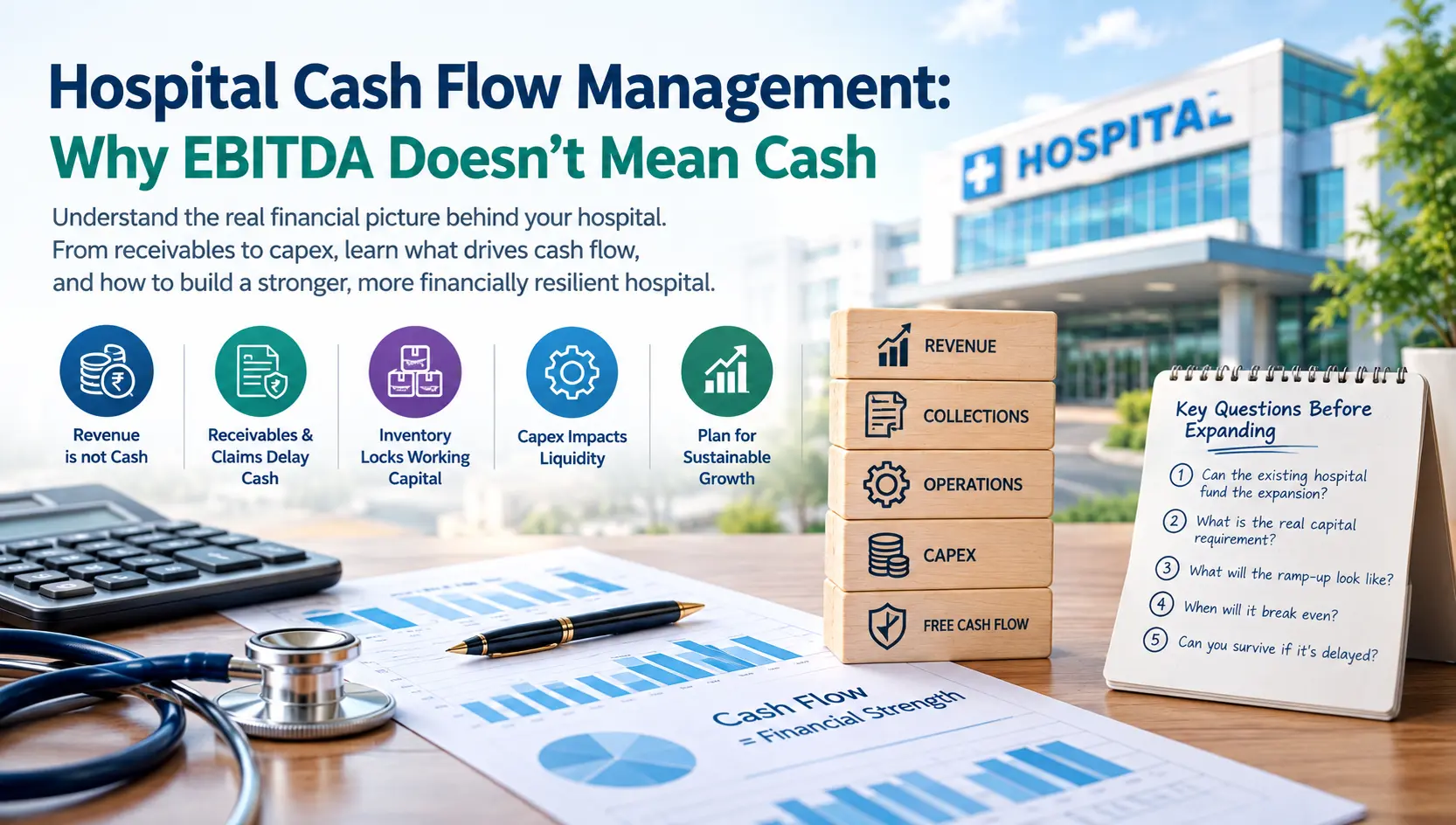
A hospital can report ₹10 crore EBITDA and still struggle to pay its vendors.
Sounds strange?
It isn’t.
This is one of the most important financial realities in healthcare. A hospital can grow revenue, improve EBITDA and even report a healthy profit while still facing pressure when salaries, consultant payouts, vendors, debt obligations and new investments have to be funded.
The reason is simple:
Profit is an accounting outcome. Cash is a liquidity reality.
In a capital-intensive business such as healthcare, the distance between the two can be surprisingly large.
This is why hospital cash flow management is just as important as revenue growth and EBITDA performance.
The Hospital That Made ₹10 Crore EBITDA — But Needed Another ₹2 Crore
Imagine a hospital generating ₹50 crore in monthly revenue.
It reports:
EBITDA: ₹10 crore
On the P&L, the business appears healthy. The CEO sees a 20% EBITDA margin.
But at the end of the month, the CFO says:
“We need another ₹2 crore to meet our immediate cash commitments.”
How can a business generating ₹10 crore EBITDA need more cash?
The answer becomes clear when we look beyond the P&L.
Suppose ₹35 crore of the ₹50 crore revenue comes from:
- Insurance
- TPAs
- Corporate contracts
- Government schemes
The hospital may have recognised this revenue according to the applicable accounting rules. But much of that money may still be sitting in:
- Accounts receivable
- Unbilled accounts
- Claims awaiting submission
- Claims under query
- Claims under adjudication
- Claims subject to deductions
Meanwhile, the hospital’s cash expenses do not wait.
- Salaries have to be paid.
- Doctors have to be paid.
- Medicines have to be purchased.
- Vendors have to be settled.
- Utilities have to be paid.
- Debt obligations have to be serviced.
The hospital therefore has a simple problem:
It has earned the revenue, but it hasn’t collected the cash.
That is where hospital cash flow management begins.
EBITDA Is Performance. Cash Is Reality.
EBITDA is a useful measure of operating performance.
It shows how the underlying operations are performing before interest, taxes, depreciation and amortisation.
But EBITDA does not tell us how much cash the business has generated.
Consider two businesses.
Both generate:
₹20 crore EBITDA.
Business A requires relatively little reinvestment.
Business B operates a highly capital-intensive hospital requiring continuous investment in:
- Buildings
- Medical equipment
- Technology
- Infrastructure
Both businesses have the same EBITDA.
But they may generate very different free cash flows.
That difference matters.
Hospitals don’t pay salaries with EBITDA.
They don’t pay suppliers with EBITDA.
They don’t buy an MRI with EBITDA.
They don’t repay the principal on a loan with EBITDA.
They pay with cash.
This is why hospital financial management needs to look beyond EBITDA and examine operating cash flow, capital expenditure, working capital and free cash flow.
₹1 Crore Billing Does Not Mean ₹1 Crore Cash
This is where the hospital revenue cycle becomes critical.
Imagine a hospital bills ₹1 crore during the month.
The CEO sees ₹1 crore of revenue.
But what happens next?
If it is largely self-pay business, collection may happen relatively quickly.
If it is an insurance or TPA case, the journey can be very different.
The claim may move through:
Billing → Documentation → Claim Submission → Query → Adjudication → Approval → Deduction → Settlement
By the time the final cash reaches the bank account, the original ₹1 crore may have become a very different number.
For example, an illustrative claim could move through:
₹1 crore billed
↓
₹92 lakh approved
↓
₹86 lakh finally collected
The numbers will vary by payer, contract and claim.
But the financial principle remains:
Billing is not collection.
And collection is what ultimately creates liquidity.
The ₹5 Crore Receivable That Looks Like Wealth
Consider another hospital.
It has ₹5 crore sitting in accounts receivable.
On paper, that looks like an asset.
And it is.
But ask the hospital CEO:
“Can you use that ₹5 crore to pay tomorrow’s salaries?”
The answer is obviously no.
This is similar to owning a piece of land worth ₹5 crore. The asset may be valuable, but unless it is converted into cash, it cannot meet an immediate cash obligation.
This is why the quality and ageing of receivables matter as much as the absolute amount.
₹5 crore receivable due in 15 days is very different from ₹5 crore sitting beyond 180 days.
The real question is not:
“How much is our receivable?”
It is:
“How much of our receivable will become cash, when will it become cash, and how much may never become cash?”
That is a fundamental question in hospital cash flow management.
Where Hospital Cash Gets Trapped
Hospital cash can get trapped in several areas.
1. Receivables
Insurance, TPA, corporate and government business can create long collection cycles.
The longer the collection cycle, the more working capital the hospital needs.
2. Unbilled Accounts
A patient may still be admitted while services are continuously being delivered.
The hospital is incurring costs every day.
But until the bill is finalised and submitted, the revenue may remain outside the collection cycle.
A hospital with poor discharge-billing discipline can therefore have significant cash trapped before the claim has even entered accounts receivable.
3. Denials and Deductions
Suppose a hospital submits ₹1 crore of claims.
Poor documentation, coding errors, eligibility issues, package disputes or non-payables may result in deductions.
The problem is no longer only delayed cash.
Some of the expected cash may disappear permanently.
That is why revenue leakage can be a bigger problem than simply having high receivables.
4. Inventory
Consider the pharmacy, OT, ICU, cath lab and other clinical areas.
Every one of them needs inventory.
If the hospital carries excessive stock, cash is sitting on shelves instead of sitting in the bank.
A hospital therefore needs to ask:
“How much inventory do we need to operate safely — and how much are we simply carrying because our supply chain is inefficient?”
Inventory is not just a procurement metric.
It is working capital.
The Hospital That Became 75% Occupied — And Still Had a Cash Problem
Occupancy is one of the most closely watched hospital metrics.
But occupancy alone does not create cash.
Imagine a 100-bed hospital.
It moves from:
45% occupancy → 75% occupancy
Everyone celebrates.
But suppose most of the incremental business is:
- Low-yield
- Heavily discounted
- Slow-paying
At the same time:
- Drug consumption increases.
- Consumable consumption increases.
- Nursing requirements increase.
- Consultant payouts increase.
- Working capital requirements increase.
- Receivables increase.
The hospital is busier.
Revenue is higher.
But cash pressure can actually increase.
This leads to an important distinction:
More patients do not automatically mean more cash.
A better hospital financial question is not simply:
“How full are our beds?”
It is:
“What contribution are we generating from each additional unit of capacity — and how quickly is that contribution converting into cash?”
Occupancy, ARPOB, clinical mix, payer mix, contribution margin and collection efficiency therefore need to be viewed together.
Growth Can Create a Cash Crisis
Here is one of the biggest paradoxes in healthcare:
Growth can consume cash before it generates cash.
Imagine a hospital generating ₹5 crore a month.
The promoter decides to grow aggressively.
A new specialty is launched.
Three senior consultants are hired.
New equipment is purchased.
Additional nurses and technicians are recruited.
Marketing expenditure increases.
Inventory is stocked.
The hospital’s revenue eventually rises from:
₹5 crore → ₹8 crore
The headline looks fantastic.
But what happened to cash?
- Capex increased.
- Payroll increased.
- Doctor payouts increased.
- Inventory increased.
- Receivables increased.
- Marketing increased.
The hospital may therefore require substantially more working capital before the additional revenue begins generating sustainable free cash flow.
This creates an important distinction:
Revenue growth is not the same as value creation.
The more important question is:
“How much capital did we deploy to generate that growth — and what return are we getting on that capital?”
That is a core principle of hospital financial management.
The Star Doctor Paradox
There is another familiar situation in hospitals.
A hospital wants to enter a new market.
It hires a highly reputed consultant with a strong patient following.
The doctor brings patients.
Revenue increases.
Everyone is happy.
But suppose the doctor comes with:
- High fixed cost
- Revenue guarantees
- Infrastructure requirements
- Additional nursing and support staff
- Marketing commitments
The hospital may see revenue growth without equivalent contribution growth.
This does not mean star doctors are bad economics. A strong doctor can transform a market.
But the CEO needs to evaluate the incremental economics, not simply the incremental revenue.
The question should be:
“What contribution will this doctor generate after the full cost of acquiring, supporting and retaining that business?”
And then:
“How quickly will that contribution convert into cash?”
That is the difference between a revenue mindset and a capital-allocation mindset.
The ₹3 Crore MRI and the EBITDA Blind Spot
Now consider capital expenditure.
A hospital buys an MRI machine for ₹3 crore.
The machine may:
- Increase capacity
- Improve clinical capability
- Generate additional revenue
But the entire ₹3 crore does not simply appear as an expense in the P&L in the month the machine is purchased.
The asset is capitalised and depreciated over its useful life.
That is one reason EBITDA can look healthy even while significant cash has left the business.
Now imagine two hospitals.
Both generate:
₹20 crore EBITDA
Hospital A spends ₹3 crore on maintaining and upgrading its asset base.
Hospital B spends ₹10 crore.
Both report the same EBITDA.
But their cash economics are clearly different.
This is the EBITDA blind spot in a capital-intensive industry.
EBITDA tells us something important.
But it doesn’t tell us everything.
The CEO needs to move further down the financial architecture:
EBITDA → Operating Cash Flow → Capex → Free Cash Flow
That is where the real financial strength of the business begins to emerge.
The P&L Can Look Healthy While Cash Gets Weaker
This is why the three financial statements need to be understood together.
P&L
The P&L tells us about:
- Revenue
- Expenses
- Profitability
over a period.
Balance Sheet
The balance sheet shows what the business owns and owes at a point in time, including:
- Cash
- Receivables
- Inventory
- Debt
- Other assets and liabilities
Cash Flow Statement
The cash flow statement explains how cash moved through:
- Operating activities
- Investing activities
- Financing activities
A hospital CEO should therefore never look at EBITDA in isolation.
Consider a hospital with:
Revenue ↑
EBITDA ↑
Receivables ↑
Inventory ↑
Capex ↑
Debt ↑
Cash ↓
The P&L may still look attractive.
But the financial architecture is sending a warning signal.
The CEO’s Hospital Financial Dashboard
If I were sitting in a hospital CEO’s review, I would want to see more than revenue and EBITDA.
I would want a dashboard covering the following areas.
Growth Metrics
- Revenue
- Patient volumes
- Occupancy
- ARPOB
Profitability Metrics
- EBITDA
- EBITDA %
- Contribution margin by specialty/service line
Cash Conversion Metrics
- Cash collections
- DSO
- AR ageing
- Payer-wise outstanding
- Collection efficiency
Revenue Leakage Metrics
- DNFB / unbilled accounts
- Denial rate
- Deduction rate
- Billing turnaround time
Working Capital Metrics
- Inventory days
- Payable days
- Receivable days
Capital Allocation Metrics
- Capex
- Maintenance capex
- Expansion capex
- Debt obligations
- Free cash flow
Because a hospital CEO needs to understand not just:
“How much did we make?”
but:
“Where is the money?”
The Hospital Financial Architecture
A practical way to think about hospital financial performance is:
Revenue → Billing → Collection → Working Capital → EBITDA
Then:
Operating Cash Flow → Capex / Debt / Reinvestment → Free Cash Flow
And ultimately:
Sustainable Growth
Every stage matters.
Revenue without collection creates receivables.
Revenue without contribution margin creates low-quality growth.
EBITDA without cash conversion creates financial illusion.
Growth without capital discipline creates cash stress.
Expansion without free cash flow can create dependence on external capital.
The objective is therefore not to maximise EBITDA alone.
The objective is to build a hospital where:
Operations + Profitability + Cash Conversion + Capital Allocation
work together.
That is the foundation of sustainable hospital financial management.
The CEO’s Final Question
The next time a hospital announces:
“Revenue grew 25% and EBITDA grew 30%.”
That is important information.
But don’t stop there.
Ask four more questions:
- How much cash did we generate?
- How much cash is trapped in receivables and inventory?
- How much capital did we consume to generate this growth?
- How much free cash flow is available to fund the next stage of growth?
Because in a hospital:
Revenue tells you the size of the business.
EBITDA tells you the operating performance.
Cash tells you the financial resilience.
Free cash flow tells you the capacity to sustain and fund growth.
Ultimately:
A hospital doesn’t survive because it reports EBITDA. It survives because it converts operating performance into cash — and allocates that cash intelligently.
Key Takeaways: Hospital Cash Flow Management
- EBITDA and cash flow are not the same.
- Hospital revenue can remain trapped in receivables, unbilled accounts and claims.
- Billing does not guarantee collection.
- Receivable ageing matters as much as total receivables.
- Inventory is a working-capital investment.
- Higher occupancy does not automatically mean stronger cash flow.
- Revenue growth can consume cash before it generates sustainable free cash flow.
- Doctor economics should be evaluated using contribution, not revenue alone.
- Capital expenditure can create a significant difference between EBITDA and free cash flow.
- Hospital CEOs should review the P&L, balance sheet and cash flow statement together.
- Sustainable growth requires disciplined cash conversion and capital allocation.