
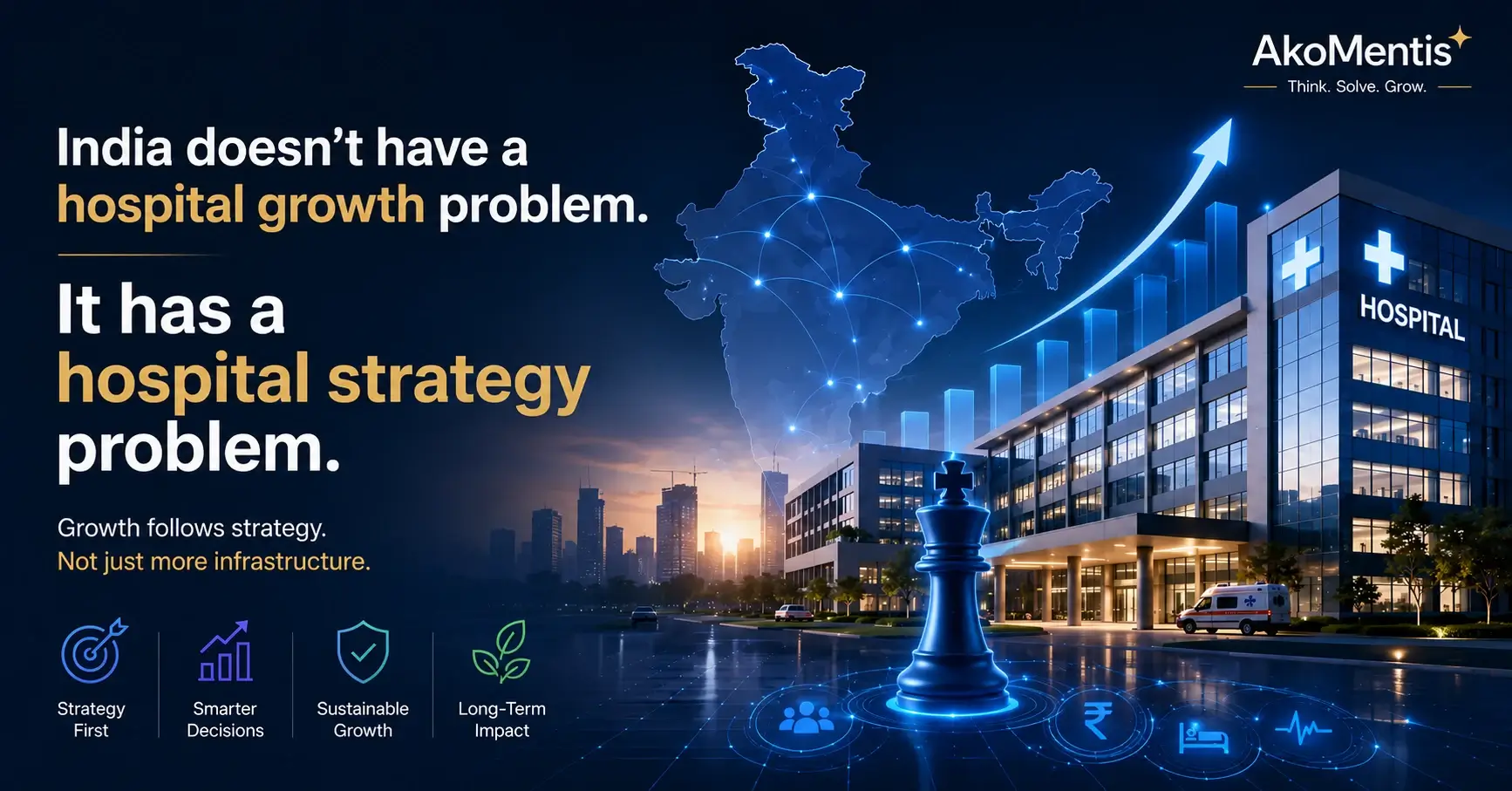
Every boardroom discussion in Indian healthcare eventually converges on the same theme: growth.
More beds. More cities. More acquisitions. Bigger campuses.
Yet quietly, many hospitals that expanded aggressively over the last decade are struggling—with margins, talent churn, governance stress, brand dilution, and patient dissatisfaction.
This is not because India lacks healthcare demand. It’s because growth has been mistaken for strategy.
Demand is not the constraint. Design is.
India’s healthcare demand story is undeniable—aging populations, lifestyle diseases, insurance penetration, and urbanization all point upward. But demand does not automatically translate into sustainable institutions.
Too often, hospitals extrapolate demand into capacity without answering harder questions:
- What care model fits this geography?
- What specialty depth will truly differentiate us?
- What talent system will scale with us?
- What governance model will survive complexity?
Growth without these answers creates capacity, not capability.
Occupancy is a vanity metric
High occupancy is frequently celebrated as proof of success. In reality, it often hides structural fragility:
- Poor case-mix quality
- Overdependence on a handful of clinicians
- Margin compression masked by volume
- Burnout-driven throughput
Hospitals don’t fail because beds are empty.
They fail because economics, talent, and systems don’t scale at the same pace as beds.
One-size-fits-all expansion is a myth
Hospital economics are deeply shaped by geography.
Urban expansion benefits from density, referral concentration, and faster ramp-up—but faces relentless margin pressure. Tier-2 and peripheral markets offer demand headroom, but only if hospitals redesign:
- Care delivery models (right-sized specialties, tele-enabled services)
- Talent strategies (visiting consultants, task-shifting)
- Pricing aligned to local affordability and payer behavior
Replicating urban hospital models in non-urban markets is not expansion.
It’s strategic laziness.
M&A is about integration, not assets
Hospital M&A failures are rarely valuation errors. They are integration failures.
Cultural incompatibility, delayed clinical standardization, fragmented IT and billing systems, and misaligned incentives quietly erode post-merger value. Assets can be acquired quickly. Institutions cannot.
Buying hospitals is easy.
Building a unified operating culture is not.
Talent is the true currency of expansion
Capital is available in Indian healthcare. Talent is not.
Growth stalls when leadership bandwidth is stretched, specialist concentration risk emerges, and nursing pipelines weaken. These constraints directly impact throughput, outcomes, and experience.
Capital builds infrastructure.
Talent builds institutions.
Hospitals that don’t institutionalize leadership development and clinical depth inevitably plateau—regardless of funding.
Branding cannot fix operational truth
Marketing spend increases visibility, not preference.
In India, doctor brands often outpace hospital brands because referral ecosystems—not campaigns—drive growth. Trust compounds slowly and erodes quickly.
Hospitals don’t lose trust through advertising mistakes.
They lose it through inconsistent outcomes, fragmented experiences, and poor communication.
Brand is not built by messaging alone.
It is a lag indicator of clinical and operational credibility.
Patient experience trumps bed counts
Patients aren’t metrics. They’re the verdict.
Expansion chases volume, but often ignores the full patient journey—from discovery to discharge and beyond. Scale erodes experience when:
- Wait times balloon despite more beds
- Care fragmentation confuses families
- Digital tools lag, creating paperwork chaos
- Feedback remains trapped in complaints desks
Hospitals celebrate 90% occupancy.
Patients remember the hour-long ER wait or the uncoordinated follow-up.
Loyalty isn’t built on availability.
It’s earned through seamlessness.
Without designing experience into growth, capacity becomes a churn engine.
Governance breaks before finances do
Governance failures rarely announce themselves. They surface indirectly:
- Decisions slow down
- Accountability blurs
- Clinical–administrative conflicts escalate
- Boards focus on compliance over capability
Promoter-led governance models that work at smaller scales struggle as complexity increases. Delegation without control creates risk. Control without delegation creates paralysis.
By the time financial stress is visible, governance failure is already embedded.
The real question hospitals must ask
The question is not: “How fast can we grow?”
It is: “What must we become before we grow?”
Indian healthcare will not reward the fastest expanders. It will reward the smartest institution-builders—those who sequence capability ahead of ambition, align promoters, boards, and investors around reality, and convert scale into resilience.
Growth is an outcome.
Strategy is the cause.
And right now, Indian hospitals don’t need more growth narratives.
They need better strategy.
LinkedIn: India doesn’t have a hospital growth problem. It has a hospital strategy problem.
Post 1/3: Growth Isn’t the Problem. Strategy Is.
Every discussion in Indian healthcare seems to revolve around growth.
More beds. More cities. More acquisitions.
Yet many hospitals that expanded aggressively are quietly struggling—with margins, talent churn, governance stress, and diluted brands.
This isn’t because India lacks healthcare demand.
It’s because growth has been mistaken for strategy.
Demand is real. But demand doesn’t build institutions.
Too often, hospitals convert demand directly into beds without answering harder questions:
- What care model fits this geography?
- What specialty depth will truly differentiate us?
- What talent system will scale?
- What governance model survives complexity?
High occupancy is celebrated—but it often hides poor case mix, clinician dependency, margin compression, and burnout.
Hospitals don’t fail because beds are empty.
They fail because capability doesn’t scale at the same pace as capacity.
Growth is an outcome.
Strategy is the cause.
(Part 2: Why replication, M&A, and capital-heavy expansion often fail)
LinkedIn: Why hospital expansion models break as scale increases
Post 2/3: Why Replication, M&A, and Capital Don’t Build Institutions
Hospital economics are not geographically neutral.
Urban markets offer density and faster ramp-up—but brutal margin pressure.
Tier-2 and peripheral markets offer demand headroom—but only if care models, talent strategies, and pricing are redesigned.
Yet many hospitals attempt replication.
Replication without contextual adaptation isn’t expansion.
It’s strategic laziness.
The same applies to M&A.
Most hospital M&A failures aren’t valuation errors—they’re integration failures:
- Cultural misalignment between clinicians and management
- Delayed clinical standardization
- Fragmented IT, billing, and HR systems
Assets can be acquired quickly.
Institutions cannot.
Capital is available in Indian healthcare.
Talent is not.
Growth stalls when leadership bandwidth stretches, specialist concentration risk rises, and nursing pipelines weaken.
Capital builds infrastructure.
Talent builds institutions.
(Part 3: Why branding, patient experience, and governance decide winners)
LinkedIn: Why branding, patient experience, and governance matter more than beds
Post 3/3: Branding, Experience, and Governance Decide Who Wins
Marketing spend increases visibility—not preference.
In India, doctor brands often outperform hospital brands because referral ecosystems, not campaigns, drive growth. Trust compounds slowly and erodes quickly.
Hospitals don’t lose trust through advertising mistakes.
They lose it through inconsistent outcomes, fragmented experiences, and poor communication.
Patients aren’t metrics.
They’re the verdict.
Hospitals celebrate 90% occupancy.
Patients remember the hour-long ER wait or uncoordinated follow-up.
Without designing experience into growth, capacity becomes a churn engine.
Governance failures rarely announce themselves. They surface quietly:
- Decisions slow down
- Accountability blurs
- Clinical–administrative conflicts escalate
Promoter-led models that worked at smaller scales strain under complexity.
The real question isn’t “How fast can we grow?”
It’s “What must we become before we grow?”
Indian healthcare will reward institution-builders—not the fastest expanders.
Read This :https://akomentis.com/the-reality-of-hospital-growth-in-india-strategy-scale-and-sustainability/